
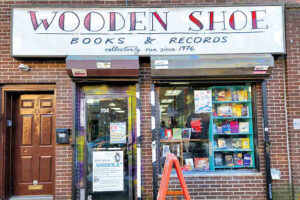
Wooden Shoe, as a publicly facing anarchist infoshop, was established in 1976 and, using capitalist projections, shouldn’t exist. Amazingly, it still does. Many visitors share stories about their parents as youthful hippies or punks hanging out on South Street in Philadelphia and coming to the Shoe to learn about the system.
 As a current volunteer described: “Wow, I was in my twenties coming out of the early New Left, SDS-gone-vanguard, mass mobilization against the Vietnam War, anarcho-curious, and searching for an anarchist project and practice or at least an attempt. The early Wooden Shoe gave me such a project in collaboration with others. Now, in my seventies, I’ve returned to Wooden Shoe as a volunteer.”
According to the U.S. Bureau of Labor Statistics, the average lifespan of a new business is about eight and a half years. So, how has the Wooden Shoe remained active for almost 50? There are several explanations.
The all-volunteer shop, which takes its name from the sabot, literally a wooden shoe worn by French peasants that would be thrown into the gears of a machine as sabotage, is located in a tourist area of Philadelphia, so the store gets a steady stream of curious visitors. It stocks a wide array of book titles, including a section on anarchism as well as LGBTQA, feminism, poetry, graphic novels, children’s and more. Monthly events also create interest.
At its start, some people involved with Wooden Shoe funded the proposed project. However, as anarchists, left libertarians and new left individuals, many with experiences in top-down leftist organizations and parties, acting as a capitalist and expecting a return on their investment was not their expectation. Rather, it is voluntary, collaborative participation that runs the Shoe and makes it a place where people want to be.
The pleasure of involvement is clearly expressed by two volunteers.
“I love the community that the Shoe cultivates. Between the volunteer collective, event organizers, and our patrons, staffing the store ensures you will meet new, like-minded people,” says one.
The other echoed that feeling, saying, “I like that being part of the Shoe allows me to make a difference in ways I wouldn’t be able to on my own. If I have a project idea that betters the communities around us, I can propose it to the collective and have their support in pursuing it.”
From the start, a fundamental aspect of anarchist relationships—consent, free of coercion, among equals—was tried. But the conundrums and contradictions were and are many. The ugh factor can be large and a sense of humor and even sarcasm is needed. Wooden Shoe exists within retail capitalism among all the other hierarchies associated with racism, patriarchy, class and other forms of systemic oppression. The store puts prices on peoples’ creative efforts and thus turns use value into price points (commodification) for books, pamphlets, patches, t-shirts, zines. It needs a legal identity to sign a commercial retail lease, and more.
The shop currently has a nonprofit status with governments, its landlord and the world at large. All this requires designated officers, bylaws, and the filing of yearly financial statements with the Pennsylvania Department of State and the IRS. So, at times participants ask themselves, is the store an authentic anarchist-oriented project or just another small retail business?
What makes Wooden Shoe an anarchist project, in addition to the store’s content, is the volunteers’ ongoing attempts within the project to relate and interact with each other based on a wide array of anarchist constructs—non-hierarchical interactions, consensus among equals, including in decision-making, inclusivity, and transparency with sharing on procedures, finances, history. They also strive for ongoing self-awareness and self-evaluation of our identities and personal histories and their impact on involvement and relationships in the Shoe. Many view the project in the context of the long-standing anarchist tradition of prefigurative politics, trying to embody the visions of a collective anarchist future. Often this is a difficult effort and participants fall short.
Those involved with the Wooden Shoe describe themselves as a volunteer collective. Since inception, people volunteering their time and energy have operated the project and this is a wondrous reality. Bringing in new volunteers is an ongoing process. People interested in volunteering are asked to be in general agreement with the store’s written mission statement and statement of values and to complete three training orientations. Staffing volunteers determine to what extent they will staff and/or participate in working groups as well as decision-making.
All this sounds pretty straightforward. However, every volunteer has an ongoing life—which may involve employment, relationships/family, childcare/parenting, schooling, other volunteer activities, and their own physical and mental health needs.
Thus, there are significant differences among volunteers related to how much time and energy they can give the Shoe project. This leads to an unequal distribution of in-house knowledge of projects and procedures. Sharing information and knowledge about these is an ongoing necessity for volunteers on a daily basis and at collective meetings. The arrival and exit of volunteers is continuous and is to be expected. This creates an unequal hierarchy of know-how.
Given these realities, there are practical aspects of sustaining the project. Volunteer collective meetings are currently twice a month and the bylaws state that those volunteers attending a meeting make decisions as needed. No quorum required. The notes from a collective meeting are sent to all volunteers. Anyone who cannot attend a collective meeting, after reading the notes, is welcome to question and even block a reported decision by sharing their opinion/ objections and any proposed alternate ideas within three days of receiving them. Once they do that, then the decision is not implemented and the expectation is that whoever objects will participate in the next collective meeting to attempt to reach a consensus.
Then there’s the money thing. Leading up to the Trump election in 2016 and since then, revenue beyond expenses at the Wooden Shoe has increased. What to do with this money has been an ongoing decision for the collective. Funds have been set aside as a safety margin. The preference of the collective is to give away most of this additional money. At monthly collective meetings, funding proposals to organizations, including other nonprofits, are considered. Some groups request funding—from local Philadelphia-based organizations to ones around the world. This past year, the collective has donated funds or printed materials to thirty organizations and groups. (Fifth Estate note: Including to this publication. Thank you, comrades!)
In addition, Wooden Shoe is a supporter of the Philadelphia Area Cooperative Alliance (PACA). Through PACA Wooden Shoe offers no interest loans to Philadelphia based cooperatives. We expect to soon provide loan funds to an immigrant craft outlet and a BIPOC herbalist collective.
Carl Craft is a Wooden Shoe volunteer. The collective would like to thank the founders and early volunteers—Frank, Ben, Louise, Adrian, Steve, Barbara, and Albo. woodenshoebooks.org or sabot@woodenshoebooks.com for more information.