
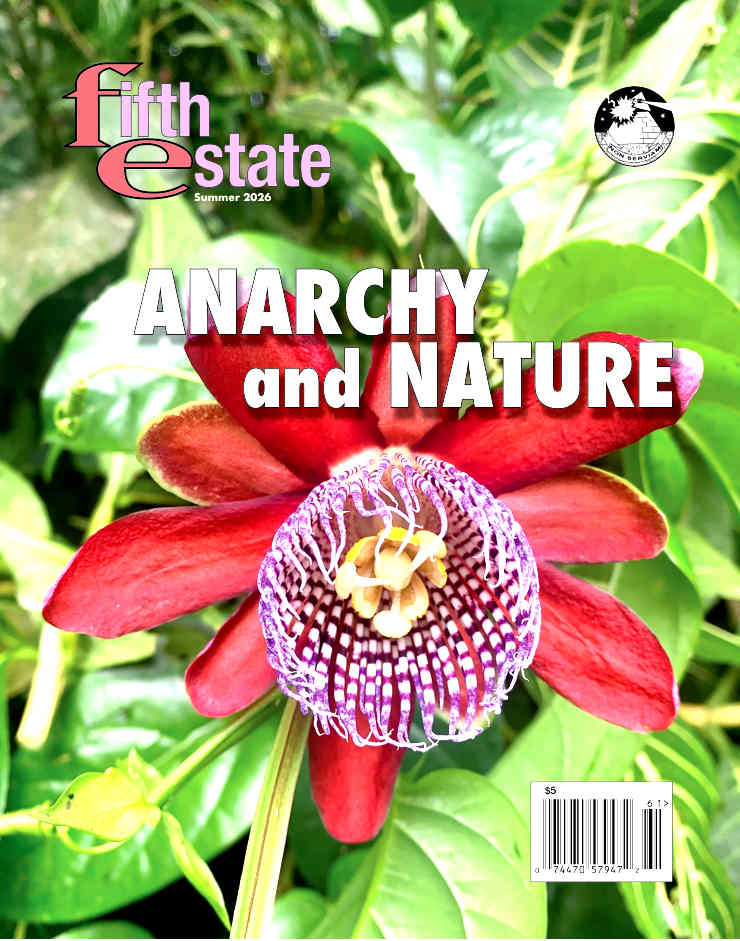
Summer 2026
Fifth Estate #418
Follows Winter 2025
CONTENTS
WORKS REVIEWED
Cancer-Industrial Complex
Nafis Hasan
Trust Kids!
Ed. Carla Bergman
Red Scare
Clay Risen
Squat the City!
Norman Nawrocki
Black Surrealist: Ted Joans
Steven Belleto
A Clean Hell
Eric King
The Art of Resistance
Susan Simensky Bietila
Our Grief Is Not a Cry for War
Jeremy Varon
Ain’t It Fun?
Aaron Lange
Surrealism b Anti-fascism Anthology
Ed. Matthias Muhling
Crossing the Race Line
Alice Echols
Often in the Right Place
John Zerzan
Imagining Surrealist Revolution
Ron Sakolsky
Loudmouth: Emma Goldman
Deborah Heiligman
ESSAYS
Of Kropotkin & Lichen
Stephen Duplantier
Marius Mason Released
Panagioti Tsolka
No Mini-Lenins
László Molnárfi
Sensing Bodies
Deep Strawberry
What is Society
John Zerzan
PM Press: 20 Years In
Nick Mamatas
A Cuban Comrade Passes
Sylvie Kashdan
Dilbert vs. Mr. Block
Hank Kennedy
All’s Well with Jesse Welles
William R. Boyer
What We’re Up Against
Lang Gore
Santa Rosa’s Insides
Stephen Duplantier
Queer and Jewish in Prison
Max Reynard
BLACK & RED BOOK OFFER
Does your book club or reading group need challenging titles?
Through the Fifth Estate, Black & Red are offering discounts on their titles to reduce stock and get books into the hands of readers. Learn more about their offer here.
MARIUS MASON RELEASED!
Anarchist trans prisoner Marius Mason has finally been released after seventeen years of a twenty-two year sentence!
Marius is an anarchist, environmental and animal rights activist as well as a loving parent, artist, poet, and musician who was given a brutal sentence for acts of property destruction. No one was hurt, no individual targeted, and yet he was given a heavy sentence with a “terrorism enhancement.” His arrest was based on snitching (including his then spouse) and FBI harassment of activists. Marius was shuffled around between prisons, isolating him from family and outside friends, but he is resilient, and despite all the challenges being incarcerated creates he has fought tirelessly for trans prisoner rights. READ MORE
Learn more about Marius & donate directly
https://supportmariusmason.org/
More info at
https://www.abcf.net/blog/welcome-home-marius-mason/
The AK Press offer of support for Marius with every order has ended.
THANK YOU AK FOR YOUR SIGNIGICANT CONTRIBUTION!
https://www.akpress.org/
FIFTH ESTATE BOOK BAG
WITH CLASSIC FE
“NON SERVIAM” LOGO

It’s $15 plus $5 postage HERE.
SPECIAL OFFER: A new 4-issue subscription plus the Book Bag is $30 postage paid HERE.
CALL FOR SUBMISSIONS
We seek writing & art related to literature, including reviews, articles, interviews, poetry, & fiction.
NEVER SUBMIT!
Except to the Fifth Estate

This selection of Peter Werbe’s essays from the pages of the Fifth Estate explore some of the basic themes the publication addresses: anarchism, capitalism, technology, civilization, racism, patriarchy, politics, culture, music, the environment, his trips to Cuba, and other subjects.
Order from the Fifth Estate online store. Check out our Specal Offers when you subscribe or renew.
SUBSCRIBE AND MORE
VISIT THE FIFTH ESTATE
ONLINE STORE FOR…
PRINT EDITION SUBS / RENEWALS
FIFTH ESTATE T-SHIRTS
SPECIAL OFFERS
VIETNAM
The US assault and resistance to it from an anarchist/anti-authoritarian perspective: it’s all here at the Fifth Estate’s Vietnam Resource Page.
SPANISH REVOLUTION OF 1936-1939
Learn more about it and the important role of the anarchists….
at Fifth Estate’s Spanish Revolution Resource Page.